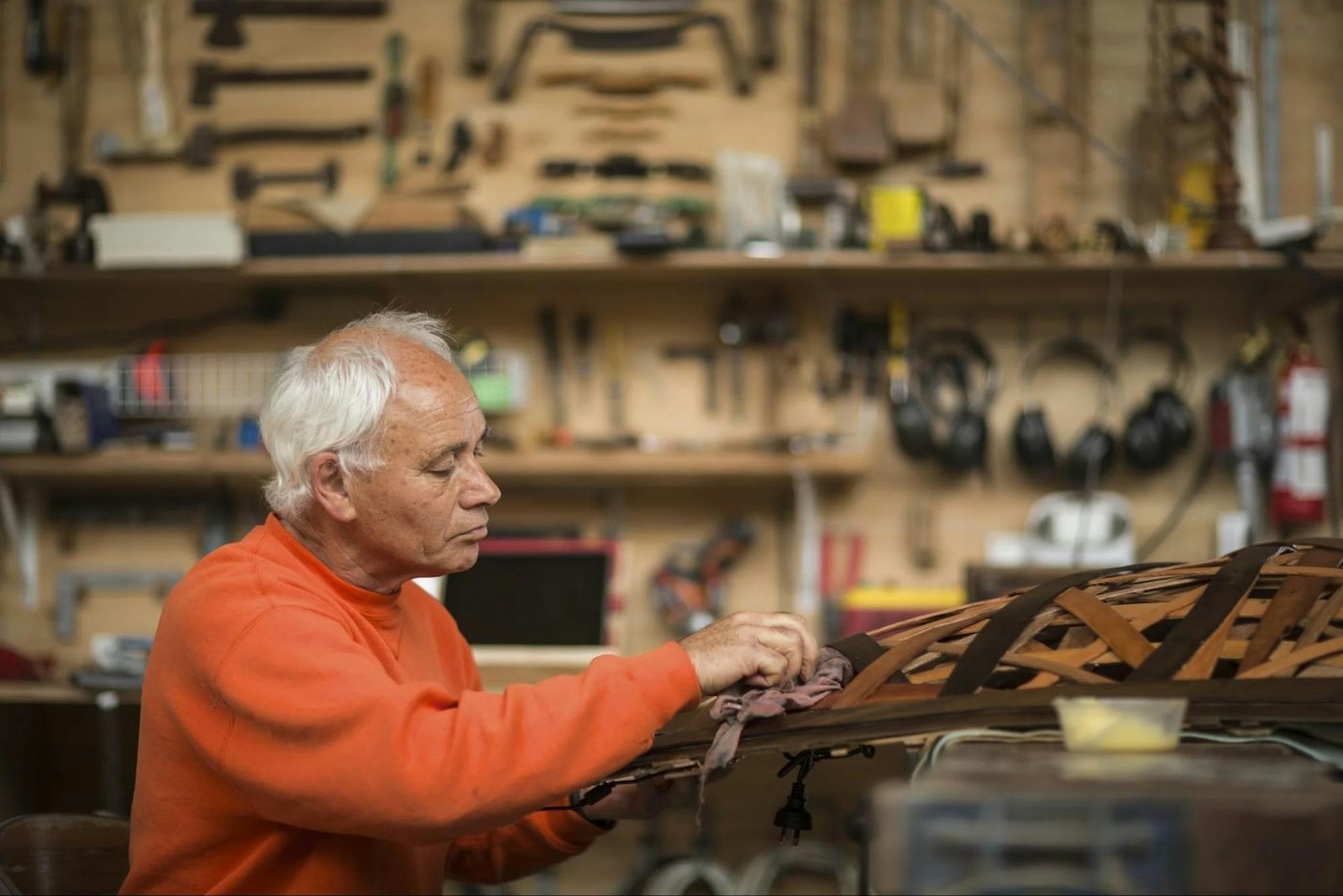
Carin Wilson (Mātaatua, Ngāti Awa, Tūhourangi) is designing a Pae for Tōtara Reserve, in the Pohangina Valley in the Manawatū.
A furniture maker in Ōtautahi
Carin left law school in the 1970s and became a furniture maker in Ōtautahi Christchurch. It started with a practical problem: he and his wife needed furniture for their first cottage. He adapted old kauri tubs, and found something in the timber he can only describe as its spiritual essence. He has since spoken of rākau as a companion and a refuge, something that nurtures him. His first major exhibition, at the Canterbury Building Centre, ended with a furniture retailer buying the whole collection.
Design that belongs to its place
He works mostly in native timber, often alongside steel, bronze, and fibre-reinforced concrete, and he has long argued that design should belong to the place it is made. In the 1980s he pushed back against New Zealand’s reliance on imported design traditions and called for a design language of our own, shaped by the whenua and the materials found here. He was the first furniture maker elected president of the Crafts Council of New Zealand, and his advocacy helped secure government funding for craft education at polytechnics.


Starting Artiture
In 1987 he helped start Artiture, an annual furniture exhibition in Auckland that ran for seven years. Until then, New Zealand studio furniture shows had centred on fine woodworking. The Artiture makers set out to design furniture as art, without having to answer to a commercial market, and they worked in metal, glass, clay tiles, and fibreglass as well as timber. Carin’s own pieces included a chair called Royal Pain in the Arse, a pointed joke about the Crown.


Leading Māori design
Carin founded and directs Studio Pasifika, a design and architecture studio whose work includes the Māori Television studio interiors. He was also the first chair of Ngā Aho, the national network of Māori design professionals, which formed in the mid-2000s after a Ministry for the Environment urban design protocol failed to engage with Māori aspirations. Ngā Aho supported the development of the Te Aranga Design Principles, since adopted by Auckland Council and used to guide public realm projects around the country. The network, which received the Royal Architectural Institute of Canada’s International Prize in 2024, has named Carin one of its Kāhui Whetū, senior practitioners recognised for advancing kaupapa Māori design.
Recognition and a retrospective
In 2024 he became an Arts Foundation Te Tumu Toi Laureate, the first recipient of the Design Award gifted by the Crane Foundation. The panel recognised his work across furniture making, education, architecture, and advocacy, and his mentoring of emerging Māori creatives. This year Objectspace has mounted a retrospective, He maramara tupu aranga: Carin Wilson and 50 years of Aotearoa design. After a winter season in Tāmaki Makaurau Auckland, it is at the Sir Miles Warren Gallery in Ōtautahi Christchurch until 1 November.
The Tōtara Reserve Pae
Carin usually joins a project while the brief is still being written. He works with communities, clients, project managers, and engineers, and says the objectives sometimes change as the concept develops. He puts mana whenua and community collaboration at the centre of the work.
That is how the Tōtara Reserve Pae is taking shape. The regional park protects a stand of old native forest, and Carin is developing his concept with a working group that brings together Horizons Regional Council, mana whenua, and people from the valley. For a maker who has spent his working life with native timber, a forest named for its tōtara is a fitting place to be working.
Wā
Wā is the third part of Paererewā’s name. It is also where Carin’s concepts begin.
“My Paererewā concepts are based on true communication exceeding boundaries of time and space, a complex concept defined as Wā throughout Moana-nui-a-Kiwa,” he says. “Wā transcends traditional notions of time and ignores supposed boundaries between physical and spiritual.”
It is an idea close to the heart of Paererewā: a Pae is an invitation to sit with the whenua and think well beyond our own lifetimes. We’ll share Carin’s concept for Tōtara Reserve as it develops.