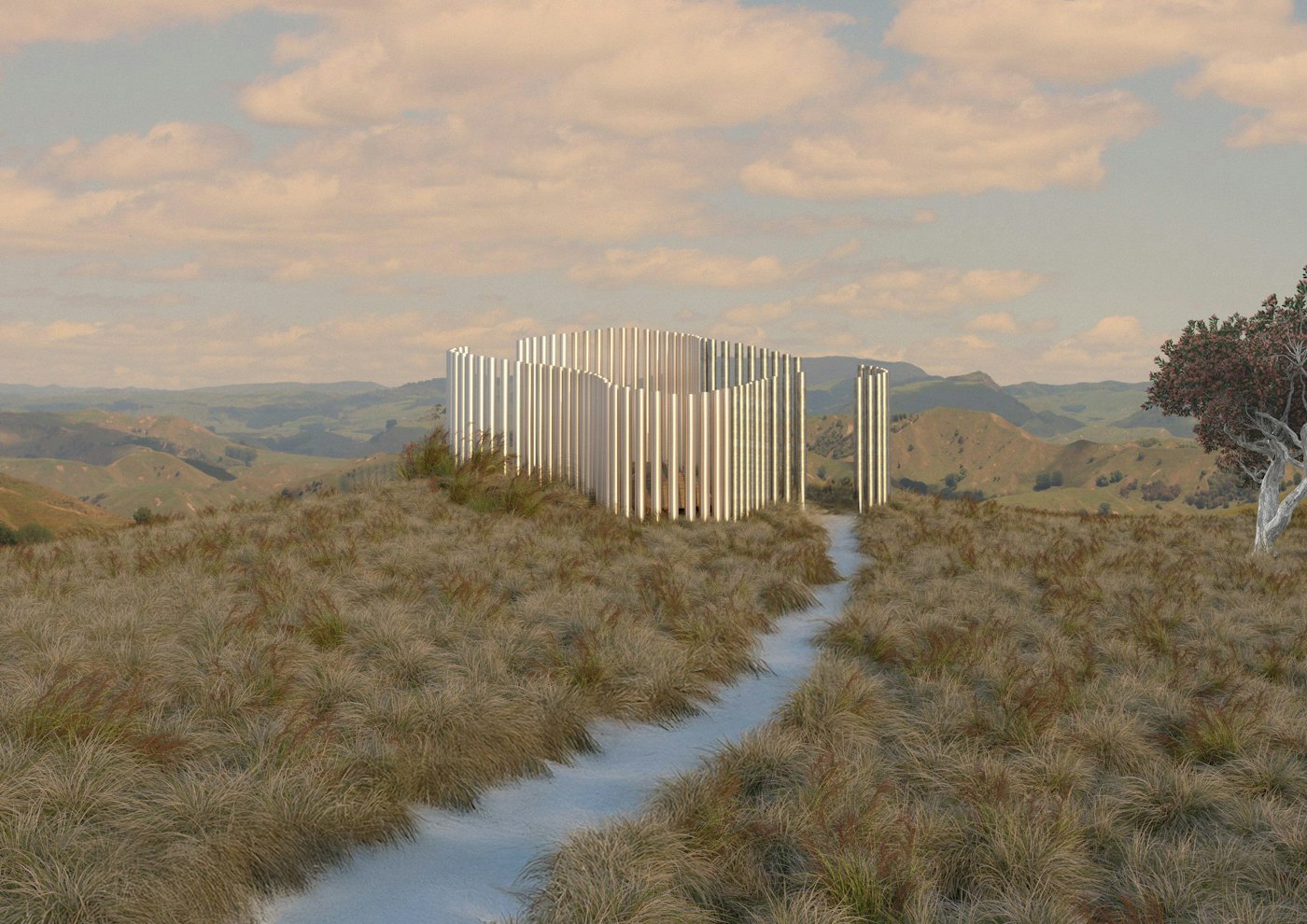
Eastwoodhill lies inland from Gisborne, in the tribal boundary of Te Whānau-a-Kai. It is the National Arboretum of New Zealand and it holds the largest collection of Northern Hemisphere trees in the Southern Hemisphere.
It is the work of one man, planted over fifty years, and of the people who chose to protect it after him.
Historical research led by Max Matenga, alongside Te Whānau-a-Kai, surfaced two things about the ridgeline where the Pae will sit.
The first is a path. Te Ara Tahito is an ancestral trail that connected Repongaere and the Kaimoe flats through Patutahi Pā and Ngatapa Pā, and inland to Te Urewera to Maungapōhatu. The path carried provisions but it also carried stories, relationships and whakapapa. This land was never isolated. It was a node in a wide network of exchange.
The second thing that emerged was that the ridge was used as an astronomical wānanga, where knowledge of the constellations and how to read a sky was passed on.


Long-term thinking
Douglas Cook arrived on this land in 1910. He found mānuka scrub, one stream that dried up each summer, and no roads. For decades, he planted trees on the land, mostly by himself. He was guided by a motto: Forward.
“In my secret heart I had envisaged my first cow paddock of six acres one day becoming a garden and shrubbery,” he wrote. “I dared not tell a soul of my hope.”
Douglas Cook was planting trees for people he would never meet. After being injured in WWI, he convalesced in Britain, visited Kew and the great private gardens, and increased the speed of his planting upon his return. He believed a garden could be a refuge from a world of hate and greed.
In 1965 the land passed to H.B. Williams, who took it on to prevent it being broken up. A decade later, when farming income proved unable to sustain the park, Parliament established the Eastwoodhill Trust to hold it.
Three long views, layered on one piece of ground: the ancestral path, the tree planter’s vision, and the steward’s care. The Pae is built around all three of these stories.


A Pae with many uses
The Eastwoodhill Pae is a ring of aluminium pou, anodised so their tone shifts as you move around the circle, each angle catching the daylight and moonlight differently. The ridge is a high wind site, and rather than fight that, the pou are made to whistle softly as air passes through them. The place gets to speak.
Three gateways open out of the ring. Inside are three seats of local limestone, set on an axis so that each seat looks out a gateway that frames a different maunga.
At the centre is what the designers call the hearth, a place to light a fire, or to set down seeds, leaves and specimens gathered in the arboretum. This space could hold a ceremony, or a small class.
Native planting will carry the work outward into the landscape around it.

Local production
The aluminium pou will be extruded in Hamilton. The limestone is local, and some of it has been donated.
Installation is planned for summer, once the ground is dry enough to get heavy stone up a steep track to the ridge.
Credits:
Design: ahha
Partner: Eastwoodhill Arboretum
Historical research: Max Matenga