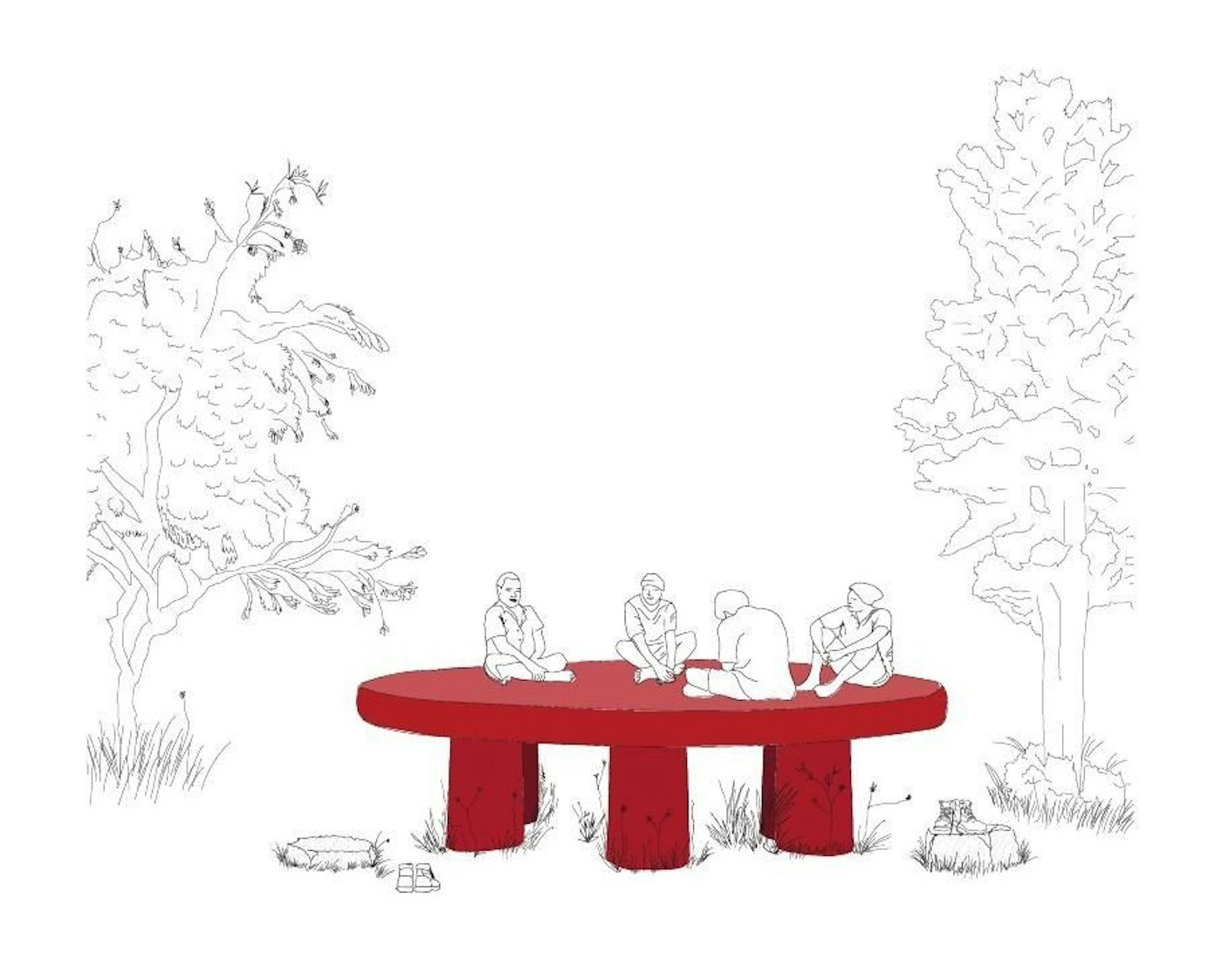
Most Pae begin with a place. This one began with a community.
Every year more than 20,000 people come from across the Pacific to work New Zealand's vineyards and orchards under the RSE (Regional Seasonal Employment) scheme, the seasonal-work programme that has run since 2007. Marlborough is the country's largest wine region, and more than 2,000 of those workers arrive here each season, many from Vanuatu, Fiji and Papua New Guinea. Some have been coming back for more than a decade. They are not visitors passing through. They are part of the place.
So when designers Hannah Broatch and Mason Rattray of Hatch Workshop set out to make a Pae with them, they did not begin with a drawing. They began by asking.
Fifty-two people came to a design event run by Hatch with the summer-season crews. What the community drew became the brief. They were clear about what they wanted: somewhere to sit together. And the community already knew the shape. Benjamin from Papua New Guinea drew a raised platform from his village in the PNG highlands, which they call a patapata. A group of Fijian workers echoed this, with a similar structure that they call vatavata. William from Vanuatu, a practising artist himself, described a comparable raised platform they call nakamal. It seems to be a form every islander knows. The trouble was, the internet barely does.


So how do you design from a form that almost no one has recorded? Hatch went looking for the form's own history. They met up with Mike Austin, a retired architectural historian who travelled the Pacific from the 1960s on, photographing the everyday buildings few others thought to document. Objectspace, who have spent years cataloguing the thousands of images in Mike's archive, helped them search.
Among the photographs of bench-like seating, often sheltered, they found it: large outdoor sitting platforms raised high off the ground, from the Ramu region of Papua New Guinea. A real precedent, in a real place, for the form the community had drawn from memory. The Pae being built now is based on that patapata, reshaped for the bank of the Taylor River in Blenheim, on the path that workers and locals already cross every day.


It is a small thing and a large one. A form carried in the memory of a community that is too often counted as labour and not as people, brought back into the open, and built to last a thousand years in the place they have helped make home.
"If there are to be 1,000 Paererewā around the country, and if they are to represent and reflect all who live here, that equates to 1 Pae for about every 5,000 people, so at minimum there should be one project dedicated to this community of workers," the designers explain. "A Paererewā centred on contemporary migrants from the Pacific ties to the history of Aotearoa, a country settled by Pacific migrants almost 1,000 years ago. It is a celebration of Pacific connections, and an acknowledgment of the contribution that RSE workers give, by coming to Aotearoa and spending so much time away from their families."
Credits: Designed by Hatch Workshop (Hannah Broatch and Mason Rattray). Archive research with Objectspace, from the photographic archive of Mike Austin.